
Hasel Magazine Spotlight: Exclusive Interview with Masaaki Hasegawa

Updated: May 28, 2025
In the latest issue of Hasel Magazine, we are honored to share an extraordinary interview with the talented artist, Masaaki Hasegawa. Discover the fascinating story of an artist whose work goes beyond boundaries and categories, leaving an unforgettable impression on the international art sphere.

Masaaki Hasegawa
Originally hailing from Japan and now based in Spain, Masaaki Hasegawa's artistic evolution is as dynamic and captivating as his creations. With a background in business and a passion for calligraphy, Masaaki embarked on a transformative journey that would lead him from the corporate world to the realm of artistry.
At 21, Masaaki began his professional career as a MMA fighter, demonstrating his early penchant for discipline, determination, and physical prowess. However, his journey took an unexpected turn when he graduated from Rikkyo University and embarked on a career as a licensed investment strategist at Daiwa Securities in Japan. It was during this time that Masaaki honed his skills in strategic thinking and analysis, laying the groundwork for his future endeavors.
Driven by a thirst for knowledge and a passion for creative expression, Masaaki pursued a master's degree in Visual Media Communication at IE University in Spain, marking the beginning of his international journey. Since 2014, Masaaki has called Spain home, where he launched Creativida (Creativida closed in 2022), an online platform dedicated to sharing the wisdom of great minds such as Guy Kawasaki and Chris Hadfield, empowering individuals to unlock their full potential.
But Masaaki's impact extends far beyond the digital realm. As a published author, public speaker, and professional coach, he has inspired audiences around the globe with his insights and expertise. From international conferences to one-on-one coaching sessions, Masaaki's dedication to empowering others shines through in everything he does.
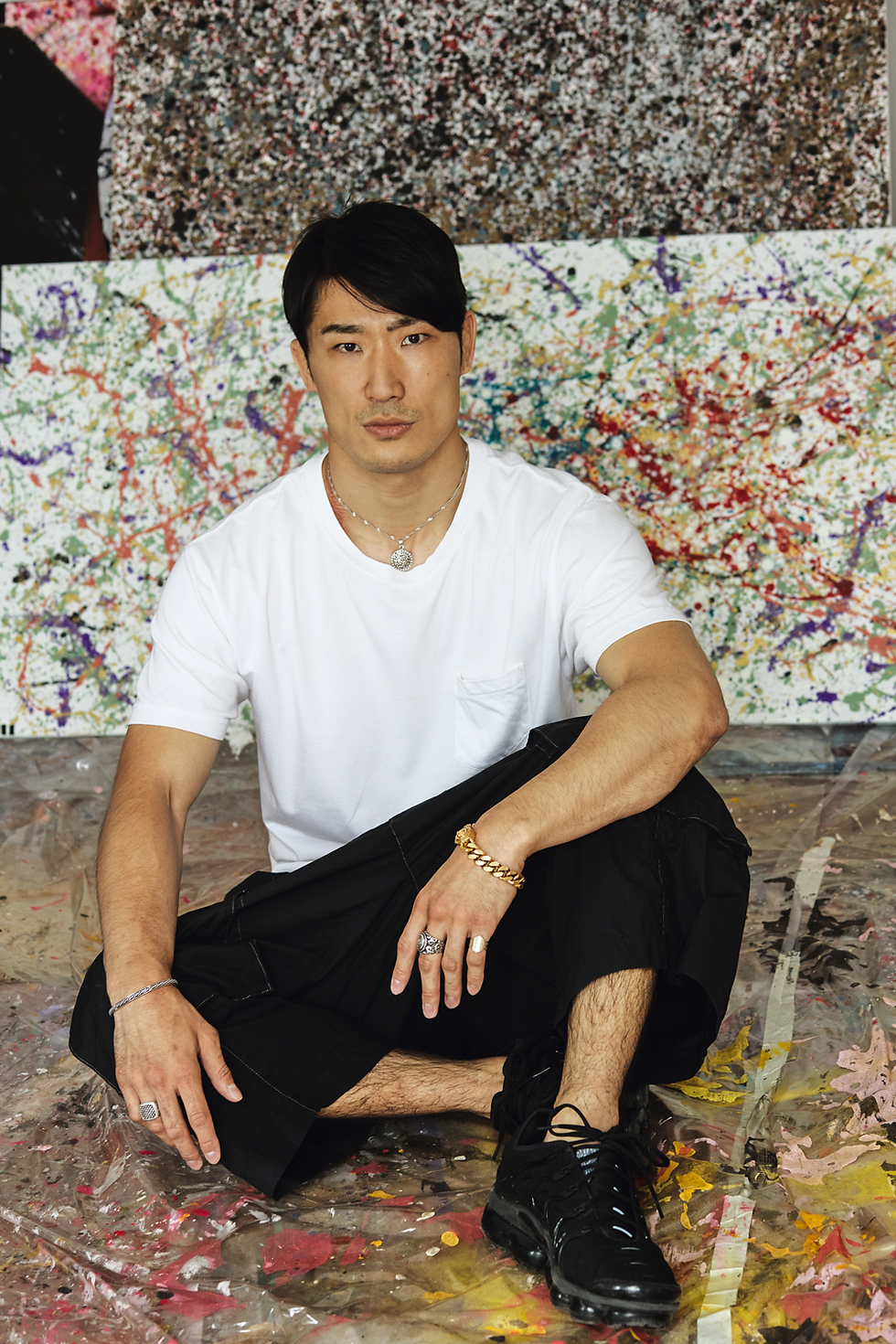
Masaaki Hasegawa
In addition to his coaching work, Masaaki has forged connections between Spanish creativity and Japanese craftsmanship, bridging cultures and fostering collaboration across continents.
Masaaki Hasegawa / Calligraffiti
Drawing upon his expertise in calligraphy, Masaaki has pioneered a distinctive style that seamlessly blends traditional techniques with contemporary concepts. His conceptual paintings speak to a desire to connect people in the modern world, as demonstrated by his groundbreaking project, 'Connect People Thru Art Beyond Borders'
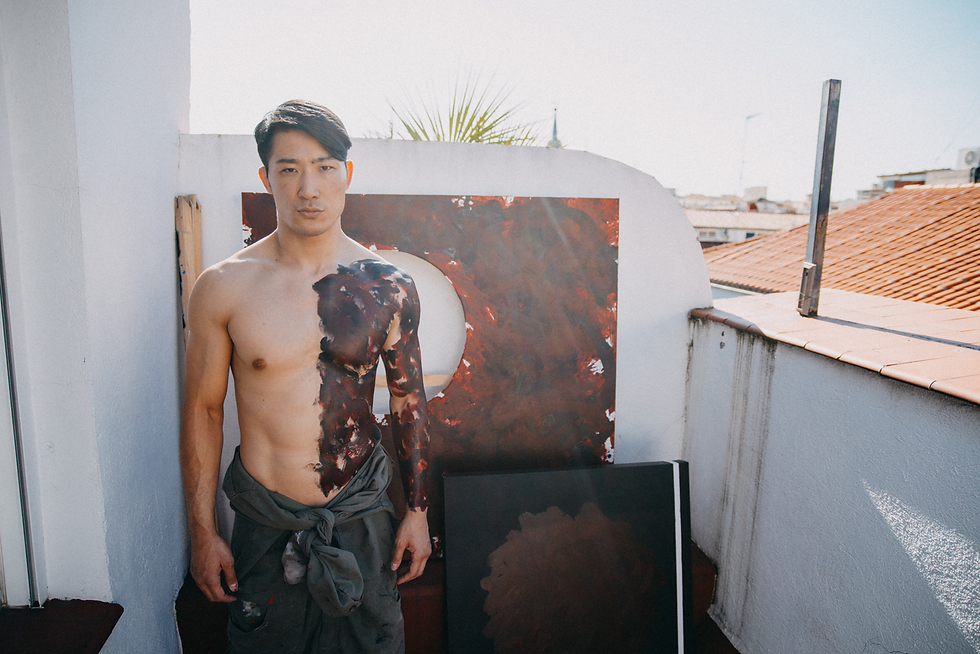
Masaaki Hasegawa
Like the ever-changing facets of nature, Masaaki Hasegawa's art undergoes a continual transformation. With each brushstroke, he captures the essence of this perpetual evolution, reflecting not only his own growth but also the dynamic interplay between humanity and the natural world.
In Masaaki's art, one can discern the subtle shifts in mood, the ebb and flow of emotions, and the evolving landscapes of the mind. Just as nature adapts to the seasons, his work resonates with the rhythms of life, embracing change as an integral part of the creative process.
From the serene tranquility of a moonlit night to the vibrant energy of a sun-drenched morning, Masaaki's paintings mirror the kaleidoscope of experiences that define the human condition. Each piece is a testament to the beauty of impermanence, inviting viewers to embrace the fleeting moments that shape our existence.
As Masaaki himself once said, "Like nature, I change, and my art changes." Indeed, his work serves as a reflection of this profound truth, inviting us to embrace the ever-changing landscape of our lives with grace and appreciation.
Directed by Nadia Bove / Assistant Fernando García / One
Masaaki Hasegawa / A Dialogue With Nature
His story is a testament to the power of perseverance, curiosity, and creativity to transcend boundaries and shape a life of purpose and passion.
Masaaki Hasegawa / Obsession and Transition
HASEL Magazine: Welcome, Masaaki! It's a pleasure to have you here. Let's dive right in.
What initially drew you to the art of calligraphy, and how has your cultural background influenced your artistic style and perspective?
Masaaki Hasegawa: It was kind of a coincidence that I started art. I had published several books in different languages about creativity before starting art. It was my passion to democratize creativity because I always felt the education system is not designed for us to flourish our creativity and potential we have but to standardize our capabilities and skills. When I had a talk event at the bookstore of Reina Sofia Museum (where Picasso’s Guernica is displayed), people asked me why I do not practice art because most people associate creativity with art and design. That made me think it would be a great demonstration of my message that everybody can be much more creative than they think, especially because I had no background or education in art. I decided to be an artist but I had no idea what to do. When I was in the finance world, I always wrote down my ideas using unreadable letters in English to stimulate my imagination and also protect my ideas from others. So, I decided to develop my art based on this format. Also, in my elementary school in Japan, calligraphy class was mandatory and I was always amazed by beautiful calligraphy. In that sense, using letters for my art happened very naturally. These days, I search for my roots and background as “Japanese” and express the concept of Japanese beauty in the Western contemporary art context, but at that time, my interest was exploring Western culture and putting myself away from Japanese culture.
When I was working in finance in Japan, I felt my personality was "very direct," "challenging authority," and "questioning everything," and did not fit the Japanese culture. Especially in Japan, people like to follow rules and social norms strictly without having a doubt. So, for me, leaving Japan was a decision to leave everything behind like “there is no way back” and rebuild everything from scratch. Thus, I did not even think about creating art related to Japanese culture. But after I started art, I was diagnosed with Asperger's Syndrome (a type of Autism) which told me it was not just my personality that did not fit Japanese culture but it was an inborn condition that I could not accept to do something I do not understand why. It does not matter whether I’m in Japan or Spain. Since then, I started to feel everything in my life is now connected. As a result, I could have developed a different approach to relationships with my own culture and started exploring Japanese culture and its beauty.
Masaaki Hasegawa / Caligrafía a gran escala
HASEL Magazine: Could you walk us through your creative process when conceptualizing and executing large-scale calligraphy artworks, such as the one on the rooftop of Zapadores Museum in Madrid?
Masaaki Hasegawa: I need to clarify this would be more about the creation of “abstract expression painting” and it would be a completely different process of design, architecture, or even figurative art on a large scale. It is just in my case I would say. I feel nothing can be more beautiful than what nature creates. So, I always try to capture the beauty of nature. This could be influenced by my background and roots such as living with synesthesia, having lived in Australia in the first years of my life, growing up in Japan, practicing martial arts, etc…
That being said, the bigger the artwork, the more dynamic the way I create. One of the reasons is that the bigger scale makes it more difficult to control everything and the small scale is more like everything is under control. So, imagine when you practice surfing near the seashore, it is quite easy to anticipate from the beginning to the end of the surf experience. It is relatively easy to choose the waves to catch and escape from danger because you may be able to even stand in the water. You still have power and the option to choose the environment and adjust it for comfort. However, when you go far from the seashore where you encounter bigger waves coming from different directions, it becomes difficult to anticipate. You need to immerse yourself in the experience and all you can do is control yourself, adjust yourself to the environment, and get to where you’d like to go. Creating large-scale artwork is like surfing in water with huge waves and currents that you do not know exactly how it will end. I cannot control the entire environment. All I can do is focus on my senses, immersing myself in the experience, and following the flow of space and time. In the case of the artwork at Zapadores, in September 2018, the temperature was around 30 degrees with the clear sky, so the creation itself was quite tough physically and emotionally. Due to the time constraints I had, I needed to finalize it in just two days. So, I painted all day long without taking a rest. It was like coming out of the experience having nothing left.
The concept is just a concept. It is a creation in the head. It is beautiful when you read it sitting on a comfortable sofa with air conditioning. You can intellectually understand something. But the power of the large-scale art creation is in its execution and the beauty of it is embedded in the experience because it is more physical and experiential rather than conceptual and intellectual. There is no logical reason but obsession to create such a thing. Most people do not have such a strong obsession and that is exactly why, it is worth experiencing it for me. What does it feel like to create such a large artwork just by myself? You can understand it only when you experience it. And, Art is for me exploring all the possible experiences. I just want to see the end of the story like watching a movie.

HASEL Magazine: As an artist who has garnered international recognition, what advice would you give to emerging artists looking to establish themselves on a global scale while staying true to their artistic vision?
Masaaki Hasegawa: Obsession and insanity. Most people quit way before flourishing a seed. Most people try to be sane to fit into society. So, the combination of obsession and insanity is a strategically powerful approach to survive in the art world. Art is all about being yourself but society has taught us to be like the person next to you. So, most people are trained to develop communication skills and thinking patterns to fit a social system. It is contradictory because you are supposed to be unique and different from others in the art world but we are not trained nor educated to be so. Even in art schools, there is grading that you have to deliver what the authority asks you to do. It could be a case that you can express yourself in a unique way but your social behavior is nothing different from others. I’ve had a chance to get to know a lot of trained artists but their social behavior and decision making is nothing so different from the rest. In that sense, I often see more entrepreneurs whose decision-making is way crazier than artists. In the end, obsession and insanity are what bring you far from where you are now and what moves others because most people are afraid to have them.
So, the question is whether you can make a decision to go toward something that gives you fear and put yourself into something uncomfortable. Our instant reaction when facing an uncomfortable situation is to get back and run away. Perhaps it is good for surviving in nature. However, one of the most important roles of artists is to explore the unknown experience. So, the feeling of discomfort is often a good indicator of whether you are doing something beyond what you have explored in the past or not.
In this sense, I’ve learned a lot about how to deal with such fear through martial arts, especially grappling. Grappling, like jiu-jitsu, is a combat of positioning of the body to immobilize your opponent and get taps (give up). It does not allow striking like punching and kicking. It is very much psychological and technical rather than physical. Most people react more or less the same when they are in an uncomfortable position and that is a starting point for losing. It is true that power and speed can sometimes dominate the game but I’ve come to realize that those who can take a risk and keep calm in an uncomfortable situation can win the game. It is because most people are programmed to run away from risks and escape from uncomfortable situations. So you can anticipate what they will do next and you can influence the flow of the game. Everything is about your decision-making in each step. The question is whether you make decisions or you just react to them.
I see similar things in society as well. When it comes to decision-making, most people just react to their emotions and make similar decisions. If you can have obsession and insanity as a default standard mode, most things would be quite ordinary and non-surprising in decision-making in society. This would allow you to make decisions to move toward the direction that gives you fear and feeling of discomfort.
HASEL Magazine: Can you share any upcoming projects or collaborations that you're particularly excited about, and how they align with your artistic and social goals?
Masaaki Hasegawa: My main interest these days is to introduce my perspective as a member of the minority to those who belong to the majority. I was born with autism and more than 40% of my life has been abroad. Now, I’m a Japanese professional artist in Madrid. So, neurologically, ethnically, culturally, and professionally, I’ve always been part of the minority. Today, I’m searching for different ways to introduce the concept of Japanese beauty to the non-Japanese world.
In a nutshell, the concept of Japanese beauty is strongly tied to nature in Japan. Compared to other countries, Japan has quite a clear distinction among the four seasons but also it is full of natural disasters like earthquakes and typhoons. Recently, I had a chance to visit Dubai and experienced the strongest rain in its history. To be honest, from my perspective, the rain itself was not that strong compared to what we always experience in Japan. However, the system was not designed for such weather and as a result, everywhere was flooded. This experience made me realize that natural disasters are embedded deeply into our consciousness in Japan and have a huge impact on our sense of beauty.
We see beauty not only in flourishment but also in the entire process of life and we appreciate a lot of ephemeral beauty. Haiku, the shortest format of poem in the world that consists of 17 syllables, is designed to capture ephemeral and momentum beauty in nature. In this format of poem, language plays an important role as it creates sounds, rhythm, and flow of the scenery. It means that translating into another language does not work because it loses important elements of Haiku.
So, these days, I visualize haiku so that people do not need to translate the beauty of haiku but can feel it more directly. I’m working on a new series of paintings in nature that I paint to capture the beauty of momentum in nature. The idea of visualizing Haiku itself actually comes from my childhood experience where I used to draw an imaginary scenery of haiku that I created. This is largely thanks to synesthesia that I have visualized sounds and time and so the multi-sensorial experience of creating haiku also stimulates my imagination visually. I’m planning to bring large canvases around nature in Spain to develop this project but I’d like to expand this idea and travel around the world for the same purpose.
Masaaki Hasegawa / Naturism
HASEL Magazine: In your opinion, what are the most pressing issues facing the contemporary art world today, and how can artists like yourself contribute to addressing these challenges through their work?
Masaaki Hasegawa: I would say art (like museums and cultural centers) and the art market (like galleries and fairs) are quite different but there are some common issues. One of the biggest issues is that artists are powerless and the value of art is decided mostly by those who do not practice art.
It is the same whether you expose your art in a museum or in a gallery. Art historians, curators, and gallerists are not artists, but they decide whose artworks to be exhibited and to get opportunities. They take art history, Bio and CV, and social situations as references to decide what is good art to exhibit and decide the prices of artworks. It is very similar to finance in that sense. Finance people are just there to talk about companies, judge them, and make prices of them by taking financial statements and economic information as references.
In general, artists cannot proactively participate in the value creation chain of art but depend on those people who do not actually practice art. Artists cannot decide what exhibitions to be held in museums and galleries. Artists cannot decide the prices in the art market (also most galleries take 50% as commission). Artists have no right to participate independently in most of the important art fairs because the art fairs accept only galleries that meet certain requirements. They need to depend on galleries and expect them to choose their art for art fairs.
In the business world, even a startup can join big fairs and tradeshows by their own decision-making. Entrepreneurs and business owners even participate sometimes in the finance side aggressively to manipulate the economic value in the market. But, a lot of artists have to depend on non-artists in the art world to establish themselves, which puts artists in a powerless position.
The art world takes advantage of artists and exploits them. Many galleries put unfavorable conditions on artists in contracts. There are even galleries in which the business model is charging artists for participating in art fairs and exhibiting in the galleries instead of selling artworks to art buyers and collectors. There are even some galleries to demand signing a NDA before showing an actual contract, so artists cannot share those unfavorable conditions with others. This means that galleries are aware of what they are doing. And, the reason why artists have to depend on them is that most of them do not have economic stability and business knowledge. So, having economic independence is a key to changing the landscape.
Today, there are online art marketplaces and social media that give artists the freedom to a certain extent. However, it is still challenging to access large opportunities or establish the economic value of artwork without having relationships with those players in the art world. So, instead of expecting others to change the situation, all the artists need to speak up and establish their autonomy and independence rather than depending on those players.

HASEL Magazine: Thank you, Masaaki, for sharing your insights and experiences with us. Your dedication to bridging cultures and fostering unity through art is truly inspiring, and we look forward to seeing where your artistic journey takes you next.
Author of Souzou
Author of Si Eres Creativo
Author of New Paradigm of Creativity
Author of Have Courage to Doubt What You Believe
Supervisor of What Global Leaders Learn from Art Today
Supervisor of Digital Branding
Speaker at Thinking Heads


Comments